The Delta 55 is a compact, blade-style antenna designed for wideband coverage across a broad frequency range of 600 MHz to 6000 MHz. The antenna is ideal for applications that demand reliable performance across various wireless technologies, with primary support for 5G NR, LTE, UMTS, and GSM.
With an IP67 rating, the Delta 55 is sealed against water and dust ingress, making it suitable for both indoor and outdoor mounting applications. Supplied as standard with an SMA male connector.
Its rugged design and broad compatibility make it ideal for modern connectivity demands in a wide range of industrial and smart infrastructure deployments.
Key Features
- Supports 5G NR / 4G LTE / 3G UMTS / 2G Quad-band GSM
- Supports both LTE Cat M and LTE Cat NB-IoT
- Covers a wideband range from 600 MHz to 6000 MHz
- SMA (male) connector
- IP67 rated housing for outdoor and harsh environments
Typical Applications
- IoT and LPWAN for asset tracking, agriculture, and monitoring
- Building and perimeter security for LTE/5G-connected cameras
- Networking gateways
- Industrial wireless equipment
- Smart metering enclosures
- Ruggedised communication terminals
- Telemetry and control systems
Electrical Specifications
- Frequency Range: 600-960 MHz, 1600-6000 MHz
- Impedance: 50 Ω
- Polarization: Vertical
- Average Peak Gain: 3.6 dBi
- Peak Gain: 7.6 dBi
- Average spherically integrated total gain:
- 600-960 MHz: -3.15 dBi
- 1600-6000 MHz: -2.02 dBi
- Average Efficiency: 60%
- VSWR: ≤ 2
- Input Power: 1 W
- Directionality: Omni-directional
- Ground Plane Independent: Yes
Environmental Specifications
- IP Rating: IP67
- Operating Temperature: -30°C to +70°C
- Storage Temperature: -30°C to +70°C
Mechanical Specifications
- Color Options: Black
- Connector Options: SMA Male
- Mounting Method: Direct Connect
- Dimensions: Ø 165 mm x 26 mm x 13 mm
- Weight: 24 g
- Housing Material: ABS Black
Spectral Frequency Diagram
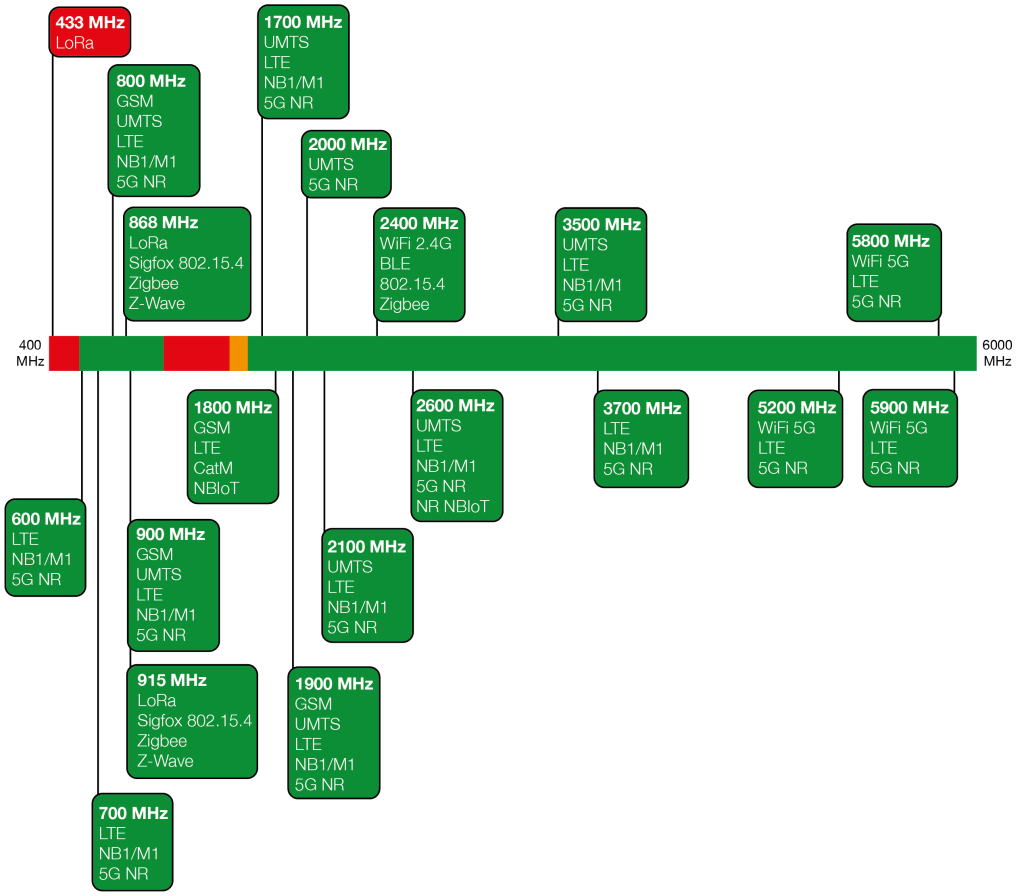
The Spectral View Diagram visually describes the performance of the antenna from 400 MHz to 6000 MHz. Key frequencies are marked highlighting the technology used, and the color represents the performance at that frequency taking in to consideration the VSWR and radiated efficiency of the antenna.
Green is considered a suitable band, amber is adequate in good signal conditions and red is likely to be unsuitable.